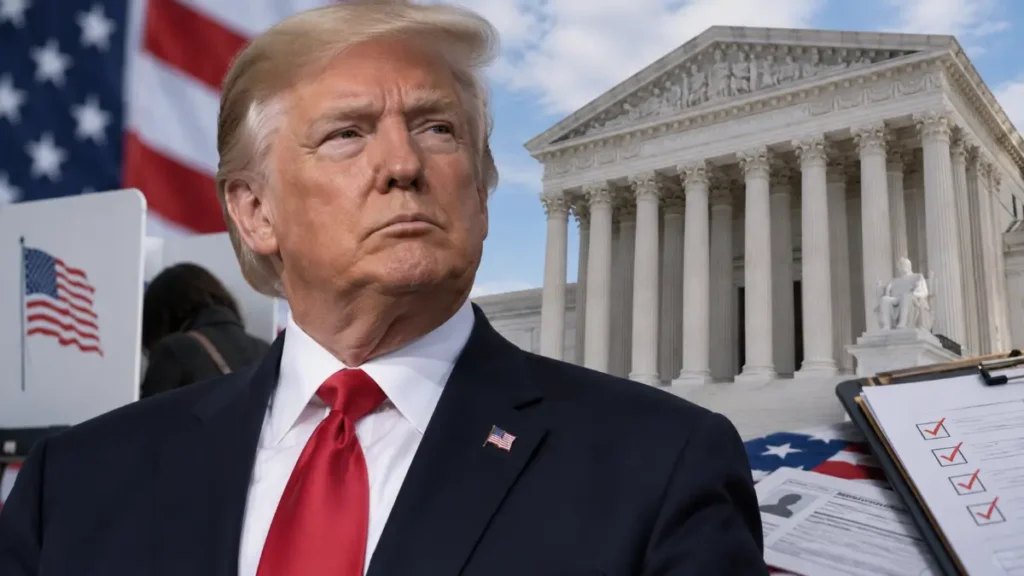
The Trump administration has taken its voter citizenship verification fight to the U.S. Supreme Court, asking the justices to revive expanded use of federal citizenship data for checking state voter rolls before the November midterm elections.
The emergency request, filed September 8, asks the Supreme Court to overturn a lower-court block affecting the Department of Homeland Security’s Systematic Alien Verification for Entitlements program, better known as SAVE.
The administration argues that states should be able to use the federal system more broadly to verify whether people on their voter rolls are U.S. citizens. Voting-rights groups challenging the policy say the expanded checks could wrongly flag eligible voters, particularly naturalized citizens.
The dispute reaches the Supreme Court less than two months before the November 3 congressional elections.
Trump voter citizenship check plan faces court challenge
SAVE has existed for decades and is primarily used by authorized government agencies to verify immigration or citizenship status when determining eligibility for certain benefits and government programs.
Election authorities can also use the system in some circumstances for voter registration and voter-list maintenance.
The current legal fight goes further.
The Trump administration expanded the way federal citizenship and identity records could be combined and made available for voter-roll verification. That effort included citizenship information drawn from SAVE and other federal databases.
A federal judge blocked the expanded approach in June, concluding that aspects of the government’s use and disclosure of personal information violated federal privacy protections.
The administration sought to keep the system operating while the case continued, but the U.S. Court of Appeals for the District of Columbia Circuit declined to lift the restriction.
In a 2-1 decision issued shortly before the latest Supreme Court filing, the appeals court left the lower-court block in place.
That ruling pushed the dispute to the nation’s highest court.
The administration says states need the federal data
The Trump administration argues that access to federal citizenship records gives states another tool for maintaining accurate voter rolls and identifying people who are not legally eligible to participate in federal elections.
Solicitor General John Sauer, representing the administration before the Supreme Court, argues that the federal government should be allowed to provide citizenship information when states request help verifying voter eligibility.
The administration has made voter citizenship verification a broader part of its election policy ahead of the 2026 midterms.
President Donald Trump has repeatedly called for tighter voter eligibility rules and stronger checks aimed at preventing noncitizens from participating in elections.
Federal law already prohibits noncitizens from voting in federal elections.
The case now before the Supreme Court is therefore not about whether noncitizens are legally allowed to vote. The immediate dispute is over how federal data can be collected, shared and used to identify possible noncitizens on state voter rolls.
Critics warn eligible voters could be flagged
Voting-rights and privacy groups opposing the administration’s policy argue that federal databases were not designed to serve as definitive nationwide voter lists.
They say incomplete, outdated or incorrectly matched information could result in U.S. citizens being identified as possible noncitizens.
Naturalized citizens have received particular attention in the case because immigration and citizenship databases contain information about their path to citizenship that may not exist for people who were U.S. citizens from birth.
The lower court cited concerns about erroneous matches and the possibility that eligible voters could face additional citizenship checks or removal proceedings based on inaccurate information.
Those concerns are central to the challenge now facing the administration.
Supporters of the policy, by contrast, argue that states should have access to as much federal information as possible when checking voter eligibility and that citizenship verification can help prevent illegal voting.
Noncitizen voting remains politically contentious
The legal fight comes amid a wider political dispute over noncitizen voting in the United States.
Trump and other Republicans have argued that stronger citizenship verification is necessary to protect election integrity.
Evidence available from prosecutions and election investigations has not established widespread noncitizen voting in federal elections.
A Reuters examination of federal cases published earlier this year identified 129 prosecutions under the federal prohibition on noncitizen voting since the law was enacted in 1996. The review did not find evidence of a coordinated nationwide voting operation involving noncitizens.
That does not mean individual illegal votes never occur. Instead, the disagreement is largely over how significant the problem is and what measures are justified to prevent it without affecting eligible voters.
Those competing arguments have made voter citizenship verification one of the more closely watched election-law disputes ahead of the midterms.
Supreme Court timing could affect the 2026 midterms
The timing of the case adds urgency.
The 2026 federal general election is scheduled for November 3, leaving election officials limited time to adjust voter-roll procedures if the Supreme Court allows the expanded federal citizenship checks to resume.
The voter citizenship case is also arriving as the administration pursues other election-related disputes before the Supreme Court, including litigation involving restrictions on mail-in ballots.
For now, the lower-court restriction on the expanded use of federal citizenship data remains in effect.
The Supreme Court has not yet resolved the administration’s September 8 emergency request. Its decision could determine whether states gain broader access to federal citizenship information for voter-roll checks before ballots are cast in the 2026 midterm elections.

The SBCC Editorial Team researches, writes, and reviews news and explainers using credible sources and official information.