
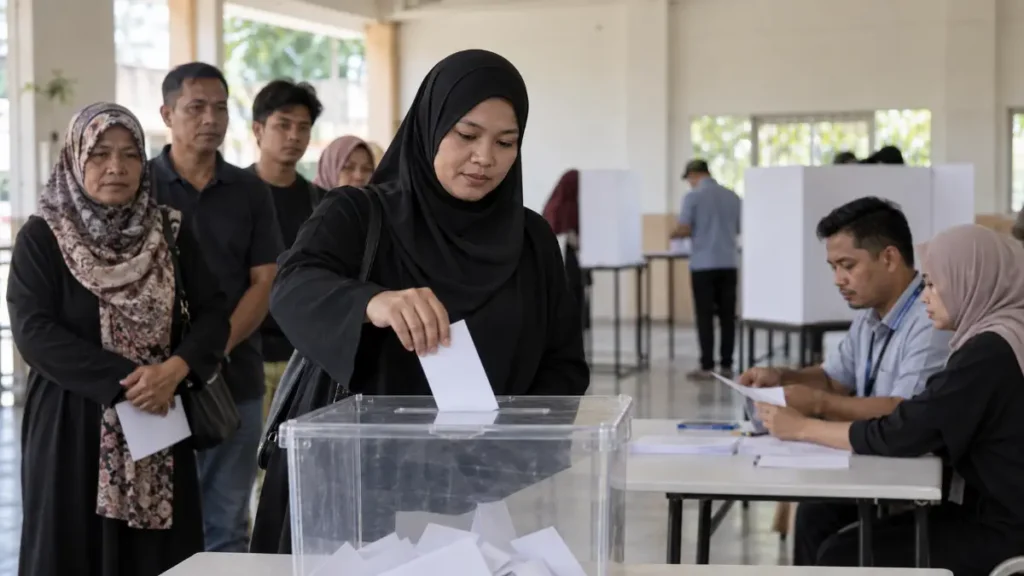
Nearly 2.4 million voters in the Bangsamoro Autonomous Region in Muslim Mindanao are preparing to cast ballots on September 14 in the region’s first regular parliamentary election, marking a major step in the political transition that began when BARMM was established in 2019.
The vote will replace the appointed Bangsamoro Transition Authority with an elected regional parliament. The election date was set under Republic Act No. 12317, signed on March 25, 2026, after the long-awaited vote was postponed several times. The law moved the election to the second Monday of September 2026.
BARMM officials say about 2.393 million people are registered to vote across 5,212 clustered precincts and 1,186 voting centers.
How the Bangsamoro Parliamentary Election Works
The Bangsamoro election is different from the national and local elections most Filipino voters are used to.
Instead of directly choosing the region’s top political leader, voters will elect members of an 80-seat Bangsamoro Parliament. The chamber is made up of 40 party representatives, 32 district representatives and eight sectoral representatives.
The party portion of the ballot uses proportional representation. Voters choose a regional political party, while district representatives compete for individual constituencies.
The sectoral seats are intended to give representation to groups including women, youth, traditional leaders, religious scholars and settler communities.
Twelve regional parliamentary political parties are taking part in the race, including the United Bangsamoro Justice Party, Bangsamoro Federalist Party, BARMM Grand Coalition and Mahardika Party.
Chief Minister Race Takes Shape
Bangsamoro voters will not directly elect the Chief Minister.
Once the new Parliament is formed, its members will choose the Chief Minister from among themselves. That means the balance of power inside the incoming chamber will determine who ultimately leads the regional government.
One of the closely watched candidates is Interim Chief Minister Abdulraof “Sammy Gambar” Macacua, who is running for the third parliamentary district of Maguindanao del Norte.
Macacua filed his candidacy as an independent. He has also received backing from political groups including the Bangsamoro Federalist Party and Mahardika Party.
His candidacy is significant because winning a parliamentary seat would leave him eligible to be considered for Chief Minister once lawmakers choose the region’s next leader.
The United Bangsamoro Justice Party, which is closely associated with the Moro Islamic Liberation Front, is also fielding candidates across the parliamentary contest and remains one of the region’s most important political forces.
Security Tightened Across BARMM Ahead of Vote
Authorities have placed heavy emphasis on security ahead of the September 14 election.
The Commission on Elections has identified 108 election areas of concern across BARMM. These areas are classified according to different levels of security risk, including previous election-related incidents, intense political rivalry and the presence of armed threats.
More than 20,000 security personnel have been deployed in connection with the election as authorities try to prevent violence and keep polling centers operating safely.
The security buildup reflects the region’s complicated political history, where clan rivalries, private armed groups and decades of conflict have affected previous elections.
Despite those concerns, election officials have said preparations are in place for voting to proceed.
Election Marks New Phase in Bangsamoro Peace Process
The election carries significance beyond simply choosing lawmakers.
BARMM emerged from the peace process between the Philippine government and the Moro Islamic Liberation Front. The autonomous region replaced the former Autonomous Region in Muslim Mindanao after voters approved the Bangsamoro Organic Law in 2019.
Since then, the Bangsamoro Transition Authority has governed the region while institutions for the new parliamentary system were established.
The September election is intended to move BARMM from that transitional arrangement into an elected system of government.
Election monitoring groups have described the vote as an important milestone in implementing the political agreements that created the Bangsamoro system and in moving the region toward regular parliamentary government.
The incoming parliament will inherit major responsibilities involving economic development, security, governance and the continuing peace process.
New Parliament Takes Office on October 30
Official results will determine the composition of the first elected Bangsamoro Parliament, including the distribution of party, district and sectoral seats.
The new Parliament will then choose the Chief Minister, establishing the region’s first elected parliamentary government.
Under Republic Act No. 12317, the terms of the newly elected officials are scheduled to begin at noon on October 30, 2026.
Until the votes are counted and the parliamentary balance becomes clear, the identity of the next Chief Minister and the shape of the new regional government remain undecided.
For BARMM, the September 14 election is a major political milestone. It will be the first time the voters across the autonomous region determine the makeup of the parliament that will govern them after years of transitional rule.

The SBCC Editorial Team researches, writes, and reviews news and explainers using credible sources and official information.